Pricing a Weehawken waterfront condo is not just about picking a number. It is about proving your value to buyers and to the appraiser who confirms the deal. If you are aiming to sell with confidence, you need a clear pricing story built on comps, view tier, and market timing. In this guide, you will learn the exact steps agents and appraisers use, what drives premiums on the Hudson, and how to set a list price that attracts qualified buyers without leaving money on the table. Let’s dive in.
Know today’s Weehawken market
Weehawken sits on the Hudson River Gold Coast, where transit access and skyline views create strong demand. Aggregators report different medians because they use different datasets and time windows. For example, Zillow’s home value index for Weehawken was $842,978 as of January 31, 2026. Use these sources for trend context, not as a substitute for building-level comps, because condo values are hyper-local by building, floor, and exposure.
What matters most for your pricing is the micro-market around your unit. Same-building sales, nearby waterfront buildings with similar exposures, and recent contract activity will paint the clearest picture.
Start with the right comps
Prioritize same-building sales
Agents and appraisers start with the sales-comparison approach and pull the most recent closed sales in your building. That is the cleanest way to control for construction, amenity package, and HOA. If same-building sales are limited, expand to your immediate waterfront corridor and then to nearby buildings with similar exposures.
Recent Weehawken examples show how prices move within the same address:
- 600 Harbor Blvd, Unit 840 sold for $875,000 on December 10, 2024, at roughly $615 per square foot.
- 600 Harbor Blvd, Unit 903 sold for $675,000 on June 30, 2025, at roughly $773 per square foot.
These two closings in the same building illustrate how size, floor plan, and exposure drive big swings in the price per square foot. A smaller, well-located layout on a stronger exposure can sell at a higher per-foot number than a larger unit.
Active listings can signal the top end of the current market but should not replace closed comps when you pick a list price. For instance, a 2-bed at 1000 Avenue at Port Imperial (Residence 306) has been marketed around $1,288,000 at roughly $994 per square foot for direct skyline and river views. Treat actives as market signals and lean on the freshest closed sales when you finalize your pricing.
Expand and justify adjustments
If you need to look beyond your building, pick comps with similar view tiers, amenity packages, and parking. Then apply time adjustments if the sales are older. Appraisers expect a clear narrative on how and why each adjustment was made.
Price the view, floor, and extras
Use view tiers and bracketing
In waterfront buildings, the biggest adjustment is often the view. Appraisers use a technique called bracketing, which compares superior and inferior views to extract a defensible value difference. That process, along with matched-pair analysis, helps quantify the premium for unobstructed Manhattan skyline and river views compared with partial or indirect exposures. You can learn more about bracketing and why it matters in this appraisal primer on bracketing and adjustments: how appraisers bracket.
Make line-item adjustments
A strong comp analysis will account for:
- Floor level and orientation. Higher floors often sell for more because the views are cleaner and sound can be lower.
- Outdoor space. A private terrace, corner exposure, or penthouse setting can command a premium.
- Parking and storage. Deeded garage parking and on-site storage are high-value adds in this market.
- Amenities. Concierge, pool, fitness center, rooftop decks, guest suites, and on-site retail raise desirability and often price.
- Condition and finishes. Renovated kitchens, refreshed baths, and turnkey condition reduce buyer friction and can support higher pricing.
Each of these adjustments should be supported by recent local evidence and explained in writing.
Why view quality changes value
Peer-reviewed research shows that water proximity and water quality have measurable effects on home values. The magnitude varies by location and by the quality of the view. This is why it is risky to apply a single national “waterfront premium.” Instead, extract the local premium with matched pairs and view-tier bracketing from nearby sales. See the meta-analysis on water amenities and value for context: water quality and property values.
Account for flood and carrying costs
Weehawken’s waterfront sits close to the Hudson River, and some parcels fall within FEMA Special Flood Hazard Areas. Lenders often require flood insurance when a property lies in an SFHA. Before you list, check your address on the FEMA Flood Map Service Center. For long-term planning and buyer questions, you can review scenarios on NOAA’s Sea Level Rise Viewer.
Be ready to discuss HOA dues and what they include, any assessments, parking fees, and typical utility costs. Clear, upfront carrying-cost details improve buyer confidence and help justify a premium list price.
Use smart pricing tactics
Pricing is part math, part market psychology. Here is how to position your condo to sell well:
- Anchor your price to the right per-foot band. Buyers search in price brackets. If your exposure and amenity tier match higher-performing comps, price within that per-foot range to attract the right buyers fast.
- Respect seasonality. Many U.S. markets see higher exposure and stronger outcomes in spring, with mid-April often cited by industry research as a sweet spot. If your timing is flexible, aim for an early spring launch with market-ready presentation.
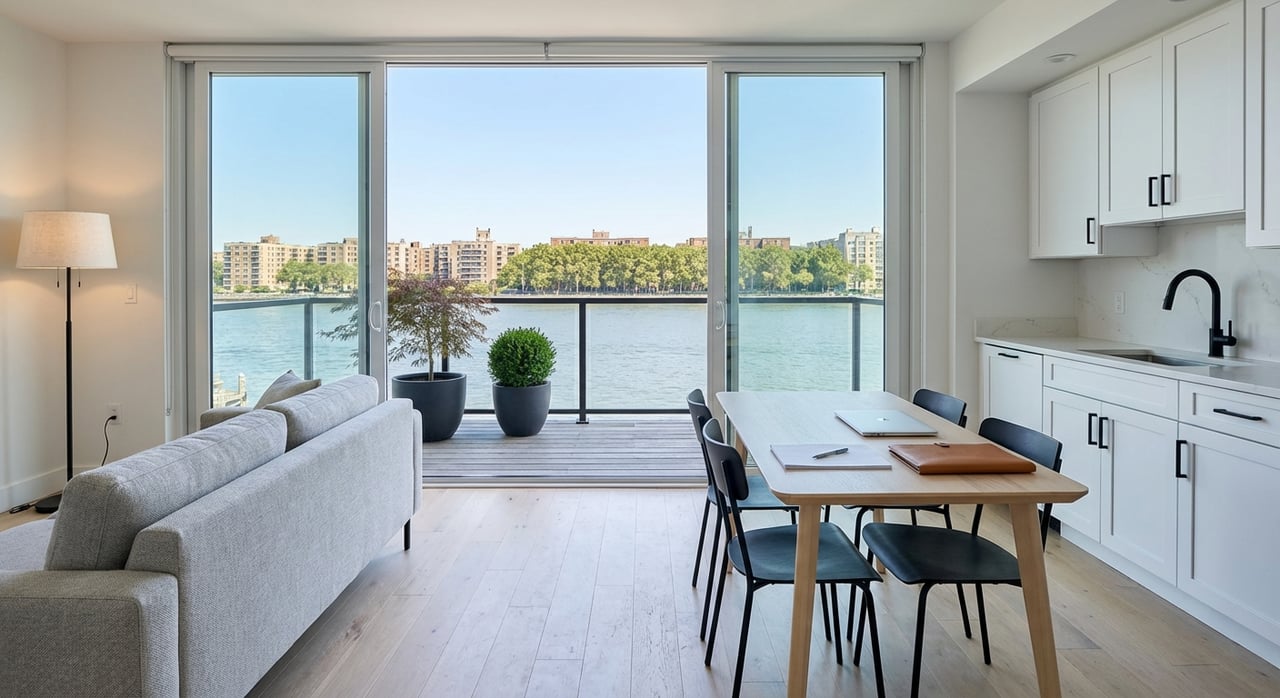
- Lead with presentation that sells the view. Use professional photography to capture morning and sunset skyline shots and any terrace space. Floor-to-ceiling windows, corner outlooks, and wide, clear compositions help buyers feel the vantage point before they tour.
- Sell the commuter story. Highlight ferry, light rail, and bus access. Link to NY Waterway schedules and terminal info in your digital brochure to reach transit-first buyers.
- Consider a pre-listing appraisal or inspection for unique units. If your condo has a rare exposure or layout, third-party documentation can strengthen your price and reduce appraisal risk.
Avoid these two mistakes
Overpricing above what the last 3 to 6 months of comps can support. This drives up days on market and creates skepticism that can follow you through price cuts.
Underpricing a rare exposure. A corner or penthouse with a direct skyline line deserves a careful, evidence-based list price. Let the comps and view-tier bracketing lead you to a narrow, defensible range.
Build an evidence-based price range
The goal is to reconcile into a tight range that you can defend to buyers, their agents, and the appraiser. A strong process looks like this:
- Pull the closest, most recent closed sales in the same building. If needed, expand to the immediate waterfront block, then to nearby buildings with equivalent exposures.
- Categorize view tiers and bracket the subject unit with one superior and one inferior comp.
- Make line-item adjustments for floor, outdoor space, parking, condition, and amenity tier.
- Apply time adjustments if you used older comps.
- Reconcile the adjusted values into a price range and select a list price that fits the current market tempo.
For a deeper look at how appraisers think through comparables, read about bracketing and adjustment logic.
A quick owner checklist
Use this short checklist to prepare for a high-confidence launch:
- Comps packet. Ask your agent for three closed sales in your building (if available), three along the same waterfront corridor, and three nearby non-waterfront sales for contrast. Include price per square foot, days on market, list-to-sale percent, exposure, parking, and terrace notes.
- HOA and building docs. Gather your resale packet, confirm monthly dues and inclusions, note any assessments, and summarize amenities.
- Flood documentation. Print the FEMA FIRMette for your address and check if an elevation certificate exists. Prepare clear language on flood insurance expectations for buyers. Use the FEMA map tool and NOAA’s Sea Level Rise Viewer for planning context.
- Pre-list third parties. Consider a pre-listing inspection or appraisal if your unit is unique or you plan to price at the top of the range.
- Marketing assets. Schedule professional photos and a brief “Why this view, why this building” memo that highlights ferry proximity, parks, and concierge or fitness amenities. Include a link to NY Waterway for commuter context.
- Launch timing. If your schedule allows, target early spring and choose a mid-week go-live for maximum digital visibility.
When to choose the final list price
After you build your adjusted-comp grid and define the view tier, your pricing decision comes down to market tempo. In low-inventory pockets or for rare exposures, you can list near the top of your supported range. In a balanced or slower pocket, list toward the midpoint to spur early showings and avoid a stale feel.
If you receive strong interest quickly, let showing volume and feedback guide your response strategy. If traffic is slow in the first two weeks, reassess position versus competing listings and tighten your price to where the most relevant comps cluster.
What the right agent delivers
Your agent should lead with data, presentation, and process. Expect a building-specific CMA with view-tier bracketing, a clear adjustment narrative, and a polished marketing plan that showcases the vantage point buyers want. That combination is how you earn attention online, maintain confidence through appraisal, and close at a strong number.
If you want a building-precise valuation and launch plan tailored to your exposure, reach out to the local specialists at Hudson Digs Realty. Request your free home valuation, and let’s position your waterfront condo to sell well.
FAQs
How should I price a Weehawken condo with direct skyline views?
- Start with same-building sales that share the same exposure, bracket with one superior and one inferior view, adjust for floor, terrace, parking, and condition, then reconcile into a tight range.
What is bracketing in a condo appraisal?
- Bracketing means selecting one comp that is slightly superior and one slightly inferior to your unit for a given attribute, such as view; this helps isolate and support the value adjustment.
Do higher floors always sell for more in Weehawken?
- Often yes, because higher floors can offer cleaner views and lower sound levels, but the actual premium depends on matched local sales and must be supported by comps.
How does flood insurance affect pricing for waterfront condos?
- If your building lies in a FEMA Special Flood Hazard Area, required flood insurance can increase carrying costs and narrow some buyers’ pools; disclose clearly and reference FEMA maps.
When is the best time to list a Weehawken waterfront condo?
- Many markets see stronger outcomes in spring, with mid-April often highlighted; if you can, align a market-ready launch with that window and lead with premium photography and commuter access.